Friday, 30 September 2011

Trends in project management 2011

I gave a free briefing on the future of project management today that identified key trends for the project management profession:

Portfolio Management

Portfolio management techniques are being used by senior management to create an organisation wide summary of all the projects and programmes that are taking place, usually with the intention of removing a larger number as part of their cost cutting or efficiency initiatives.

This means that senior managers are starting to define criteria against which they will evaluate projects before deciding if they offer sufficient value to be authorised. I think this creates an additional pressure for project managers because we now need to ensure that not only are the benefits of our project greater than the costs but we also need to ensure that they are strategically important benefits.

In the briefing we a agreed that project managers need to get in the habit of describing how their projects contribute to strategic objectives because it is the achievement of these objectives that senior management are evaluated against, and they have a strong interest in keeping their jobs!

Benefits Realisation

We recognised that benefits realisation has become a widely recognised term and that senior managers are more likely to talk about achieving the benefits than worry about what is actually being delivered.

We discussed how important it is for project managers who are delivery focused (deliver on time, on budget and to the required standard of quality) to understand how benefits can only be realised if there is successful implementation of what has been delivered.

Change Management

We examined this model to see how knowledge of change management techniques is becoming increasingly important for those working in project management:
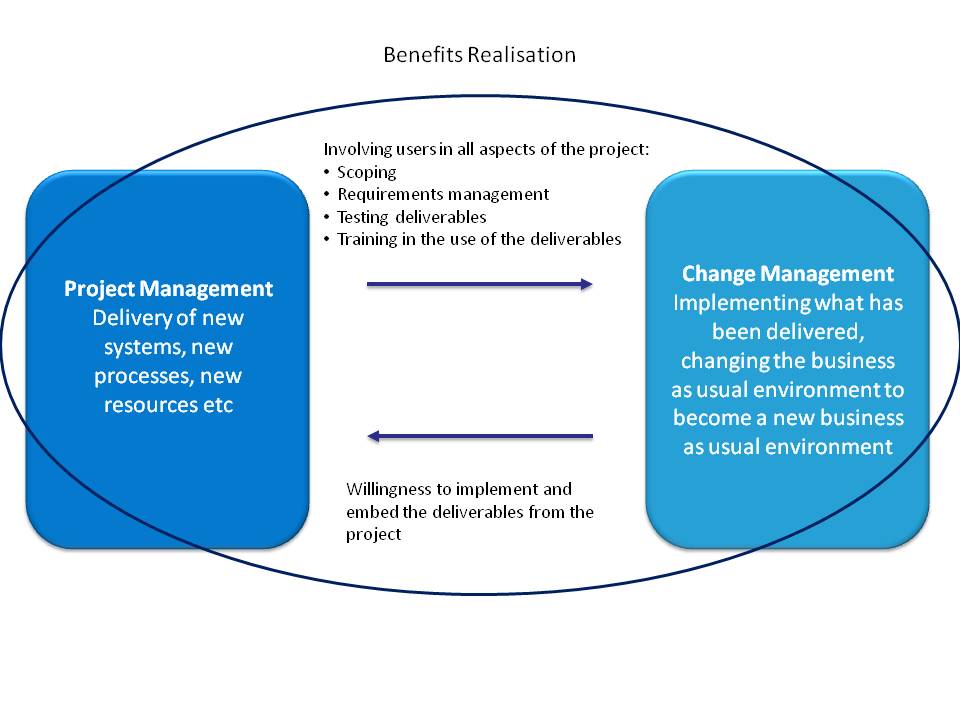


Aligning project management and change management is a hot topic. At the conference for the Association of Change Management Professionals in Copenhagen last week there were a high number of project managers in attendance, wanting to know how they could improve their project approach to include more motivation and persuasion activities to encourage operational staff to use the new systems and procedures that they have created.

Do you agree with the conclusions of those attending my briefing? Are you involved in realising benefits or portfolio management? Get in touch and let us know your thoughts.

Thursday, 22 September 2011

New book launch

Very exciting - my new book Managing Business Transformation: A Practical Guide has just been launched.
Buying this book gives you access to a ready made business change lifecycle, describing lots of change activities to move you from initial idea to successful implementation.

The change lifecycle has 4 steps:
- Understanding the change
- Planning the change
- Implementing the change
- Embedding the change

There is also a chapter on how to align the change lifecycle with a project lifecycle as I wanted to acknowledge that projects deliver change (new processes or systems etc) but that they don't usually go as far as ensuring that everyone has integrated these deliverables into how they work and therefore realised the benefits of the project.

I wrote the book because I wanted one source that would give me a change management equivalent of the project management books that explain what to do and how to do it. To buy the book go to http://www.itgovernance.co.uk/products/3561

I have had lots of positive feedback about the book, with a number of people saying they are already using some of the ideas. Jessica Wharton, APMG-International comments, “Managing Business Transformation is an easy and enjoyable read. I would happily recommend this to both experienced managers and those just starting out. As Melanie points out, even if you don’t deal directly with business transformation, knowledge on how to successfully handle it is priceless in any managerial role.” For her full review go to http://blog.apmg-international.com/2011/09/21/managing-business-transformation/#more-1944

Wednesday, 21 September 2011

Aligning project and change management practices

Have just spent 2 days with 150 project managers and change managers at the Association of Change Management Practitioners European Conference. Key topic has been the integration of change management into project management.


Although effective project managers accept that making sure what they deliver is successfully implemented is within the scope of the project lifecycle a lot of project management frameworks don’t have any formal activities or processes for encouraging this. There are also practical considerations which push change outside of the remit of the project managers:
• It is not cost effective for project teams to remain in place once development and testing of the deliverables has been completed.
• Change activities can benefit from the knowledge of the project team, but individuals cannot outsource implementation and embedding, they have to make the changes for themselves.
• Projects are expected to deliver on time, on budget and to specific quality criteria, but the pace and scope of changes that individuals adopt cannot be constrained in this way.
• The objectives of project and change activities are different. Project activities deliver the potential for change: the new processes, systems, organisation structure etc.; change activities create the persuasion, motivation and leading by example that results in the new business environment.

Organisations are now starting to address these issues and some of the actions organisations are taking include:
Renaming all project managers to change managers – as the name reinforces their responsibilities for implementation
Establishing the role of change manager and making sure that there is a change manager for every project
Defining what the change activities are and making sure the cost of them is included in the business case for the project
Building a central ‘business support function’ that is staffed by project managers and change managers who work together on projects
Changing the remit of the PMO to become a centre of excellence for project delivery and the implementation of change

Tuesday, 13 September 2011

Back to work and under pressure

There is a real ‘back to work/rushed off our feet’ buzz at Maven this week so we are trying to work smarter to fit everything in. One technique is to move as much as possible into ‘housekeeping mode’ i.e. turn tasks into regular actions that are carried out in the same way every time. The reason for this is that I want to reduce the time we take to do simple tasks so that we free up more time to be creative – to dream up new products and services, to spend more time with our clients and to look towards the future.

This approach is backed up by psychological research which explains that once we have learnt how to perform a task, our brains need less conscious thought (short term memory, which has limited capacity) to carry it out, and if we do it enough times it will move the task into our subconscious (long term memory, with lots of spare capacity).

This means that our conscious mind can spend time on more worthwhile tasks such as paying attention to what we are doing, focusing on a task, having new thoughts that lead to new ideas, learning new skills and being more innovative about how we approach things.

Although projects are all about doing new things and therefore, using lots of our conscious mind, we can make project management easier by transferring as many project tasks as possible into regular activities carried out by our subconscious. For example, logging, analysing and reporting on risks, issues and change requests, producing progress reports, sending out information to stakeholders.

By carrying out these basic tasks regularly we free up more time to spend identifying new ways of working that overcome the risks, or incorporate the requests for change. We can spend more time engaging with stakeholders, addressing their concerns and helping them to champion the project.

I believe that the methodologies offered by the Office of Government Commerce (PRINCE2; MSP; MoR; MoP; ITIL) are so effective because at their core they try to regularize as many project, programme and portfolio tasks as possible.

The methodologies set out what documents to use, in what order tasks should be carried out and which roles should perform them. This leaves managers with plenty of capacity to fully engage with their projects and programmes, managing them actively, rather than having to use their conscious brain to decide how to do basic tasks when they should be working at a higher level of creativity.

Get to know these methodologies (http://www.maventraining.co.uk/quick-guides/) to simplify your management tasks and give you the freedom to be innovative about how you tackle more challenging activities.

Wednesday, 31 August 2011

Building enthusiasm for the return to work

Now that the Bank Holiday is over I feel a sense of ‘back to workness’ that is making me organise what I need to get done between now and Christmas (only 15 weeks to go!).

It’s a good time to plan some activities that will help you learn more and develop your skills so have a look at our new download http://www.maventraining.co.uk/latestnews/your-chance-to-organise-your-q4-diary/

It is also a good time to look back on the year to see all of the extra things you have done to increase your knowledge and make sure you keep a record of them. It is always useful to have an update list of all your development activities – for your CV or to bring up at a performance review.

The sorts of activities to look for include:
• On the job training
• Participating in workshops and briefings
• Holding a coaching session
• Mentoring a colleague
• Attending exhibitions and seminars
• Formal training courses
• Acquiring qualifications
• Delivering presentations
• Undertaking research assignments

All of these activities contribute to your continual professional development. If you want to read more have a look at our quick guide http://www.maventraining.co.uk/media/19/619-introduction-to-the-structure-and-benefits-of-cpd.pdf or our new whitepaper http://www.maventraining.co.uk/media/16/816-continual-professional-development-1.0.pdf

Monday, 22 August 2011

Is new X Factor judge a natural leader?

Watching X factor last night was an interesting example of leadership. Louis Walsh, the only remaining judge from previous seasons could reasonably have been expected to take the 'head judge' place at the table and show the 'newbies' how it is done. However, from the first audition it became apparent that Gary Barlow was the true leader of the judges, with a range of actions and behaviours that led all of the other judges, Louis included, to follow him:
- He sat in the end seat previously occupied by Simon Cowell
- He sat back from the table, turned slightly away from the stage and towards the other judges in a casual gesture that indicated he was in control of the situation. This was in marked contrast to the other judges who all sat straight to the table facing the stage.
- When he disagreed with the views of the other judges he asked 'what are we doing' indicating that he expected their judging to fit with the previously stated objective of finding a 'global superstar' and indicating disdain for their childish endorsement of a clearly tone deaf Tai Chi instructor.
- He voted against the other judges in this situation clearly defining his willingness to be 'his own man' and not be swayed by the group
- During the breaks the other judges looked to Gary for leadership when returning to the stage much as the judges had previously waited for Simon Cowell to be ready before going back on stage.

Leadership is authority and control of a situation. You can decide if you want to take a leadership position in any given situation but your role will only be confirmed if others involved in the situation decide to follow you.

If you want to know about leadership, especially in the context of leading change within your organisation sign up for our change management course http://www.maventraining.co.uk/course-detail/_/change-management-foundation-practitioner/7/ and develop your leadership ability to rival that of Gary Barlow (even if your singing is not up to much!)

Monday, 15 August 2011

New resource materials

August can be a useful month for taking stock on the achievements of the year and catching up with all the research and latest trends in our areas of business. For those of you involved in project, programme, portfolio, risk and change management I thought I would share some of the most useful articles I have been reading lately – I hope you enjoy them and that they provide food for thought:

The 5 Essential Metrics for Managing IT
This article has some useful ideas for those responsible for identifying which benefits to measure for their programme or what benefits to track within the portfolio. It also has some useful ideas about how to categorise initiatives within the benefits between discretionary and mandatory projects:
http://img.en25.com/web/CitrixOnline/Forrester%20Five%20Essential%20Metrics.pdf

Risk Management Comes of Age
This is a useful article for anyone who is involved in improving their organisations approach to risk management and is looking for evidence to support their cause.
http://www.forbes.com/sites/forbesleadershipforum/2011/08/10/risk-management-comes-of-age/

Building Organisational Capability
This is a series of 4 thought leadership pieces from the APM Benefits Management Specific Interest Group and I thought the second one examining the journey to effective change management was particularly interesting:
http://www.apm.org.uk/news/delivering-benefits-investment-change-creating-organisational-capability

What Successful Transformations Share
This report summarises the results of the McKinsey Global survey on transformational change, and makes some very clear points about what drives successful large-scale change
https://www.mckinseyquarterly.com/What_successful_transformations_share_McKinsey_Global_Survey_results_2550

Using programme management to deliver strategic objectives
This paper explains the case for using programme management as a structure that brings together project and change management into a cohesive approach that will successfully deliver the strategic objectives of the organisation
http://www.maventraining.co.uk/media/92/792-using-programme-management-to-deliver-strategic-objectives-1.0.pdf

ShareThis

Share/Save/Bookmark